
1
Google never sees half of them
Vehicle pages sit behind filters and scripts that Google struggles to follow. Many are never crawled, and a car can sell before its page is indexed.

VDP SEO gets your vehicle detail pages found on Google when shoppers search for the exact car you have in stock. We fix how your inventory is crawled, indexed and described, so your own pages show up instead of a listing site's copy of them.
Send us your website
Inventory is most of your website. On most dealer sites it earns almost no search traffic, for three reasons.
Vehicle pages sit behind filters and scripts that Google struggles to follow. Many are never crawled, and a car can sell before its page is indexed.
The same title pattern and the same paragraph on every vehicle. Google sees hundreds of near-copies and picks the listing site's version.
The page disappears or shows an error. Any ranking it earned is thrown away, and the shopper leaves.
Clean links, sitemaps and filter rules so Google finds new vehicles quickly and ignores junk URLs.
Titles, descriptions and specs built from your feed, so each vehicle page is specific and complete.
Markup that tells Google the price, mileage, condition and availability of each car.
A set rule for what happens when a car sells, so traffic moves to similar stock.
A dealer website has two kinds of inventory page.
Inventory SEO is the work on both. SRPs should rank for broad searches that stay the same all year, like "used trucks" plus your town. VDPs catch the precise ones, like a year, make, model and trim. Get both right and your own site appears where a listing site used to.
A page that isn't in Google's index can't rank. On dealer sites this is the first problem to solve.
We check how many vehicle pages you have and how many Google has indexed. The gap is usually large. Then we fix the causes:
Google has little reason to rank a page that looks like every other page on your site and on three listing sites.
We build title and description patterns from your feed that include year, make, model, trim, condition and location. We check that each page shows what a buyer needs: price, mileage, real photos, features, history report and a clear next step. Missing data usually starts in the inventory feed, so we trace it there and fix it at the source.
Dealer-written comments help when they say something specific about the car. A sentence about one owner, service history or new tires does more than a paragraph of sales talk.
Structured data is code that labels the facts on a page for search engines. On a vehicle page it tells Google: this is a car, here is its make, model, mileage, price and whether it is in stock.
We check what your platform already outputs, fix errors, and add what is missing. Google can use it to show price and availability in results. AI search tools read it too.
Stock turns over constantly, so this rule matters more than any single page. The options are:
We set one rule for your site and make sure the platform follows it, so a sold car never appears as available.
Most dealerships run on Dealer.com, DealerOn, Dealer Inspire or a similar system. Car dealership website SEO on these platforms is a negotiation with what the vendor allows.
We know where the limits usually are. Some things you can change in the back office today. Some need a support ticket, which we write for you. Some can't be changed at all, and we say so instead of billing you for trying. Good dealer website SEO is mostly knowing which is which.
Each month you see how many vehicle pages are indexed, how many clicks went to SRPs and VDPs, and which searches brought them, all from Google Search Console.
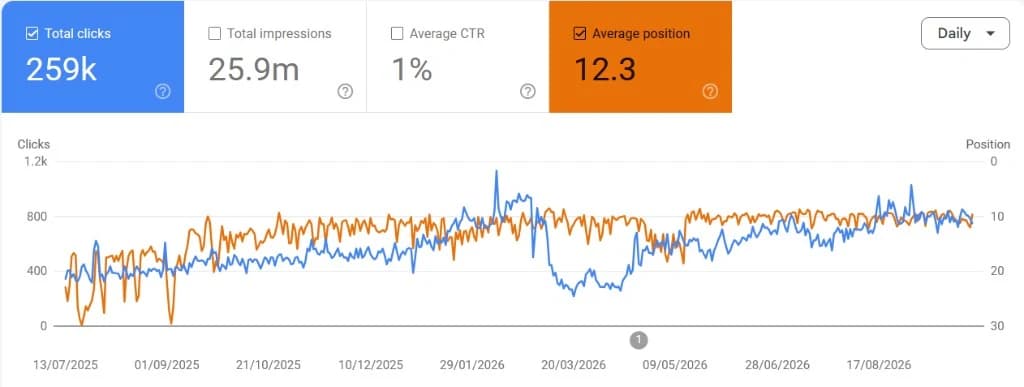
In our dealership case study, this kind of work on site structure and inventory pages added about 500 organic clicks a day. Inventory SEO works best with local SEO, and the car dealership SEO playbook shows how they connect. Our automotive SEO services page lists everything we do.
Send us your website. We'll check your inventory pages and send a written audit in 1 business day, then walk you through it on a call.
A large car dealership, competing with a dominant listing site, added about 500 organic clicks a day and doubled its traffic in three months. Then a server failure wiped much of it out, and we won it back.
We check how many of your vehicle pages Google has indexed and why the rest are missing. Written audit in 1 business day.
Sitemaps, internal links and filter rules, within what your platform allows.
Titles, descriptions and structured data for search results pages and vehicle pages.
Each month you see indexed pages, clicks to inventory and which searches brought them.
Pricing: Custom quote after your free audit.
Send us your website. You get a written audit in 1 business day, and we walk you through it on a call.
Free. Written audit in 1 business day, plus a call to walk you through it.