
Car Dealership SEO Case Study: +500 Clicks a Day, Then a Recovery
A large car dealership, competing with a dominant listing site, added about 500 organic clicks a day and doubled its traffic in three months. Then a server failure wiped much of it out, and we won it back.
Large car dealership · Competitive market · Automotive retail
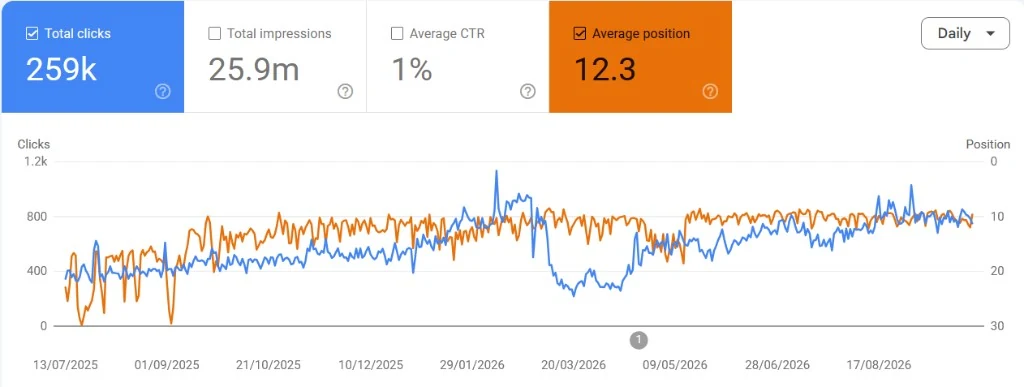
The results in Search Console
What happened
This car dealership SEO case study covers two jobs for the same client. The first was growth: about 500 more organic clicks a day, with daily traffic doubling in roughly three months. The second was a rescue. A server failure took the site down and much of that traffic with it. Overall traffic was back in about three months, and the hardest head terms in about six.
The starting point
The client is a large car dealership in a market where one vehicle listing site dominates search. It plays the role that Cars.com or Auto Trader play for dealers elsewhere. Shoppers start there, and the dealer pays to appear.
The dealership had a big, fast-changing inventory. Shoppers were searching for makes, models and body styles it had in stock. The listing site ranked for those searches. The dealership's own pages mostly didn't.
The goals
- Rank for inventory searches that don't include the dealership's name.
- Make vehicle and category pages easy for Google to find and understand.
- Win those searches without copying how the listing site builds its pages.
- Later: recover traffic and head-term rankings after the outage.
We measured everything in Google Search Console, by clicks and impressions.
What we did
Built pages that last longer than a single car
A vehicle page disappears when the car sells. So we mapped search demand to pages that stay: make, model, category and market pages. These became the stable landing pages. Individual vehicle pages sat underneath and caught the exact searches.
Internal links tied it together, so a shopper could move from a broad page to a list of cars to one vehicle.
Fixed the inventory templates
We reviewed vehicle pages for specific titles and headings, complete vehicle details, image context and correct canonical tags. The aim was not longer pages. It was accurate, consistent ones.
Filter pages and near-duplicates that served no search were kept out of Google's index, so its attention went to the pages that mattered.
Watched the technical side
We tracked crawl access, indexing and page availability throughout. That monitoring is what made the recovery faster when the servers failed.
Linked content to stock
Content focused on real inventory and the questions buyers ask about it. We skipped generic car articles that had nothing to do with what was on the lot.
The results
Before the outage, organic clicks grew by about 500 a day. Daily organic traffic reached about twice its earlier level in roughly three months.
You can see it in the Search Console chart above: a steady climb after the work began.
The server failure and the recovery
Then the servers failed. Important pages were unavailable, and organic traffic fell sharply.
Getting the site back online did not bring the rankings back by itself. Google has to recrawl pages and decide to trust them again. Our recovery plan, in order:
- Restore stable responses and crawl access.
- Confirm the key templates rendered correctly.
- Resubmit priority URLs and strengthen internal links to them.
- Check indexing and search movement by page group.
- Avoid other big changes, so we could tell whether the recovery was working.
Overall organic traffic recovered in about three months. Competitive head terms took about six months. These moved on different schedules, which is why we tracked them separately.
What this means for your dealership
Don't build your SEO on vehicle pages alone. Cars sell. Make, model and category pages stay, and they protect your traffic as stock changes.
You can outrank a listing site for your own stock. Not everywhere, and not overnight. But a dealer with a well-structured site has one thing the listing site doesn't: the actual car, at an actual location.
Uptime is part of SEO. A few days of failed pages cost this dealership months. Monitoring, backups and a clear owner for the website are cheap by comparison.
Want this checked on your site?
Send us your website for a free written audit in 1 business day. You can also read the car dealership SEO playbook, see our automotive SEO services, or go back to all case studies.
Services used in this project
Automotive SEO Services
Automotive SEO services for car dealerships: technical fixes, inventory and VDP SEO, local SEO, content and AI search. Start with a free written audit.
Car Dealership SEO Playbook
Car dealership SEO explained for dealers: inventory pages, Google Maps, service, AI search and what to fix first. A practical 2026 guide with real results.
VDP and Inventory SEO
VDP SEO that gets your vehicle pages indexed and ranking for year, make and model searches, ahead of listing sites. Start with a free written audit.
Lock your territory before your competitor does
Send your dealership URL. We'll show where organic search is leaking traffic and what to fix first.
Free. Written audit in 1 business day, plus a call to walk you through it.