
What car dealership SEO is, and why it's different
Car dealership SEO is the work of getting your store found in Google's unpaid results. You will also see it called dealership SEO, car dealer SEO or auto dealer SEO. They all mean the same job.
It is not the same job as SEO for a plumber or a restaurant. Three things make dealers different:
- Most of your pages are inventory. Hundreds or thousands of vehicle pages appear and disappear every week.
- You don't fully control your website. It runs on a dealer platform such as Dealer.com, DealerOn or Dealer Inspire, and the manufacturer has rules too.
- You compete with giants. Listing sites like Cars.com, CarGurus and Auto Trader target the same searches with far bigger budgets.
SEO for car dealerships has to be planned around all three. Advice written for other local businesses misses most of what matters.
Where shoppers find you on Google
A local car search produces a results page with several parts. Each one is a different opportunity.
- Ads at the top. You pay per click.
- The map with three businesses. This comes from Google Business Profile.
- AI answers on some searches, which name one or two businesses.
- Organic results below. This is where your pages and the listing sites compete.
Dealer SEO works on everything except the ads. The map and the organic results bring the most visitors today. AI answers are growing.
Car dealership SEO strategy: what to do first
A sound car dealership SEO strategy does things in the order that pays back fastest. This is the order we use.
1. Fix what blocks Google. If pages can't be crawled or indexed, nothing else counts. This is quick to check and often quick to fix.
2. Sort out Google Business Profile. It is free, you control it, and it feeds the map results that sit above everything else.
3. Make inventory pages rank. This is the biggest job and the biggest prize, because inventory is where your search demand is.
4. Build service and model pages. These bring steady traffic all year, whatever is in stock.
5. Earn local links and reviews. They lift everything above.
6. Measure, then repeat. Use Google Search Console to see what moved, and put the next month's effort there.
Most dealerships we look at have skipped steps one to three and gone straight to blog posts. That is why their SEO hasn't worked.
Technical SEO on a dealer website
Technical SEO means making sure Google can reach, read and store your pages. On dealer sites the same problems come up again and again.
Filters create duplicate pages. Every combination of color, price and body style can produce its own URL. Google wastes its time on these and misses your real pages. The fix is to decide which filter pages deserve to be indexed and block the rest.
Scripts slow the pages down. Chat widgets, trade-in tools and tracking tags pile up. On a phone, a vehicle page can take many seconds to become usable. Find the heaviest scripts and delay or remove them.
Sold vehicles break links. A page that ranked yesterday returns an error today. You need a rule for what happens when a car sells.
Sitemaps are stale. The sitemap should list every in-stock vehicle and update with the feed.
Structured data is missing or wrong. This is the code that labels your business details and each vehicle's price, mileage and availability for search engines.
On a dealer platform you can fix some of this yourself, some through a support ticket, and some not at all. Knowing which is which saves months.
Local SEO: winning the map
For searches like "car dealer near me" or "oil change" plus your town, the map is the first thing people see. Google picks three businesses based on relevance, distance and how well known each one is.
What moves you into those three:
- a complete Google Business Profile with the right primary category;
- separate profiles for service and parts where Google allows them;
- the same name, address and phone number on your site, the manufacturer's dealer locator and the main directories;
- a steady flow of recent reviews, with replies;
- a real location page on your website for each store.
Ask every sales and service customer for a review, with a direct link, right after the visit. Don't offer rewards and don't ask only happy customers. Both break Google's rules.
Our guide to local SEO for car dealerships goes through each step.
Inventory SEO: SRPs and VDPs
Your inventory lives on two kinds of page. A search results page (SRP) lists vehicles, such as all used SUVs. A vehicle detail page (VDP) shows one car.
They do different jobs in search:
- SRPs rank for broad searches that never go away, like "used trucks" plus your town or a make and model. Treat your main SRPs as permanent landing pages. Give each a clear title, a short useful introduction and a stable URL.
- VDPs catch exact searches, like a year, make, model and trim. Each one needs a specific title, complete data from the feed, real photos and a price.
The two most common failures are VDPs that Google never indexes, and VDPs that all look the same. Check the first in Google Search Console by comparing the number of vehicles in stock with the number of vehicle pages indexed.
Decide what happens to a page when the car sells. Redirecting to the matching SRP works for most stock. Keeping the page with a sold notice and links to similar cars works for rare vehicles.
Our VDP and inventory SEO page covers this in detail.
Content that earns its place
Dealers have been sold a lot of blog posts. Most bring no customers, because nobody nearby is searching for them.
Write content only where there is real local demand and you have something to sell:
- Model pages for your best sellers: trims, prices, what's in stock, and how the model compares with its main rival.
- Service pages, one per job: brakes, tires, batteries, oil changes, with prices or price ranges where you can give them.
- Finance and trade-in pages that explain your actual process.
- Comparison and "best for" pages when they match your stock, such as the best used family SUVs you sell under a set price.
Give each page one main search to target. If two pages chase the same search, they hold each other back.
AI search: the newest results page
Shoppers now ask ChatGPT and Google's AI answers which dealership to visit. These tools read the web and reply with one or two names.
They favour businesses whose facts match everywhere and whose pages answer questions in plain sentences. So the work is mostly an extension of good SEO: consistent business details, clear answers on your pages, structured data, and plenty of recent reviews.
Nobody can guarantee a mention. You can make yourself the easy choice. See AI search for dealerships for how we approach and test it.
SEO for used car dealers and independents
Independent and used car dealers have one advantage and one handicap.
The advantage is freedom. There is no manufacturer program limiting your website, so you can fix things a franchise store can't.
The handicap is that you have no brand name doing your marketing. Nobody searches for your store by a make they already want. You win on inventory searches instead: make, model, price range and body style, plus your town.
That makes SRPs and VDPs even more important for SEO for used car dealers. Build strong category pages for the types of car you always carry. Add pages around price, such as used cars under a set amount, because that is how your buyers search. And put extra effort into reviews, because trust is the first question a used car buyer has.
More on this in SEO for used car dealers.
Fixed ops SEO: the service department
Service and parts bring a dealership steady profit, and they are usually the weakest part of its website. A typical dealer site has one service page with a booking button.
People don't search for "service department". They search for the job: brake pads, tire rotation, battery replacement, a warning light. Each of those should have its own page saying what the job includes, how long it takes, which makes you work on and how to book.
Add a separate Google Business Profile for service if you qualify, with service hours and a direct number. Service customers come back again and again, so each new one found through search is worth far more than a single visit.
Our fixed ops SEO page covers service and parts in detail.
SEO for dealer groups
A group with several stores has a problem single stores don't: its own sites compete with each other. Two stores of the same make in neighbouring towns will chase the same searches unless someone decides who targets what.
For multi-rooftop groups we set three things:
- Territory. Which store owns which towns and which searches.
- Standards. One template for titles, structured data, profiles and listings, so every store starts from a good base.
- Reporting by store. Group totals hide weak locations. Each store should see its own numbers.
The group website, if there is one, should link shoppers to the right store and not try to outrank its own dealerships.
See dealer group SEO for how we plan this.
Car dealership SEO tips you can act on this week
These car dealership SEO tips cost nothing and take under an hour each.
- Search your own stock. Pick a car on your lot and search its year, make, model and your town. Note who appears above you.
- Check your index. In Google Search Console, compare indexed vehicle pages with your stock count.
- Open your Google Business Profile. Confirm the category, the hours for each department and the phone number.
- Test a vehicle page on your phone. Time how long it takes before you can scroll and tap.
- Click a sold car. Find an old vehicle link in your email or history and see what the page does now.
- Read your last ten reviews. Check the dates and whether anyone replied.
- Count your service pages. If there is one, you have found your quickest content win.
If you'd like someone else to do this, our free audit covers all seven and more.
How to measure dealership SEO
Use Google Search Console as the source of truth. It is free and it shows what Google itself recorded.
Watch four things:
- Clicks from searches without your name in them. This is new demand. Searches that include your name would have found you anyway.
- Indexed pages, especially vehicle pages.
- Clicks by page type: SRPs, VDPs, service pages, model pages.
- Google Business Profile actions: calls, direction requests and website visits.
Then connect these to leads where your tracking allows: calls, forms, chats and service bookings. Ranking reports alone tell you little, because rankings change with where the searcher is standing.
An automotive SEO strategy in practice: real results
An automotive SEO strategy is only as good as what it does to the numbers. Two of ours are published with their Search Console data.
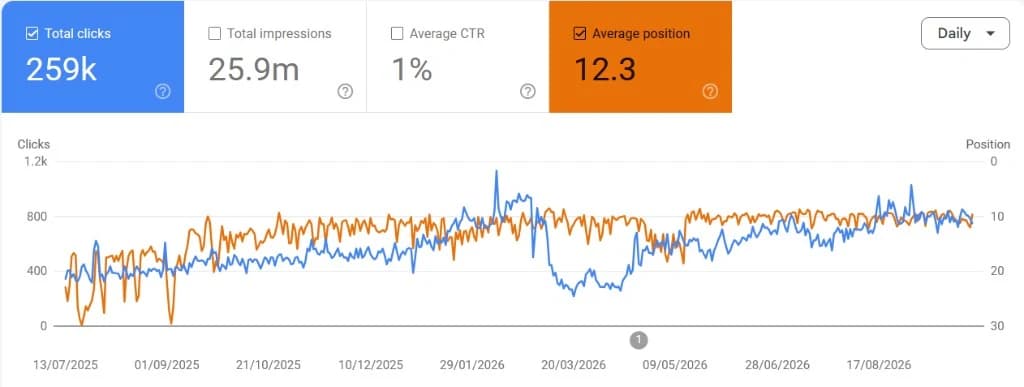
A large car dealership competing against a dominant vehicle listing site. Work on site structure, inventory pages and technical health added about 500 organic clicks a day, and organic traffic doubled in roughly three months. A server failure later wiped out much of that. Overall traffic recovered in about three months, and the most competitive searches in about six. Read the dealership case study.
A local supercar rental business. Daily clicks rose 113% and daily impressions 72% over two months, during the low season. Read the rental case study.
Both show the same pattern: fix the structure first, and growth follows within months.
How to choose help with automotive dealer SEO
If you bring in an agency for automotive dealer SEO, ask what they will change on your inventory pages, what your platform won't let them change, and whether you can see past results in Search Console. Vague answers to any of the three are a warning.
Our automotive SEO services page lists exactly what we do. We also wrote a guide to choosing an automotive SEO company that applies whoever you hire.
Get your own site checked
Send us your website and we'll run through everything in this guide on your dealership. You get a written audit in 1 business day, and we walk you through it on a call. At worst, you'll know exactly what to fix.